

Get your brand cited inside ChatGPT, Gemini, Perplexity, and Google AI Overviews.
AEO & GEO — Answer Engine Optimization and Generative Engine Optimization — is how brands earn citations inside AI search. Most agencies still sell only the 10-blue-links playbook. We sell both, and we have the AI-search receipts to prove it.
Half your buyers no longer ask Google.
They ask AI.
of US searches in 2026 happen inside or alongside AI chat — ChatGPT, Gemini, Perplexity, Claude, plus Google's own AI Overviews on the SERP.
brands are typically named in any given AI answer. The other thousand options on page 1 of Google are invisible. AI search is a much narrower funnel — higher stakes per query.
If your brand isn't one of the 3-7 names an AI engine mentions when someone asks about your category, you don't exist to that buyer. No second-page rescue. No rankings to climb. Just absence. That's the new failure mode of organic search.
Our client cited in ChatGPT + Google AI Overview, today.
Everhome Mobility — an ADA-accessibility services brand in Bergen County, NJ — gets cited in Google's AI Overview for the head query in their category, and named independently by ChatGPT (rated 5.0☆, with specific service attributes cited). Below, the screenshots from April 2026.
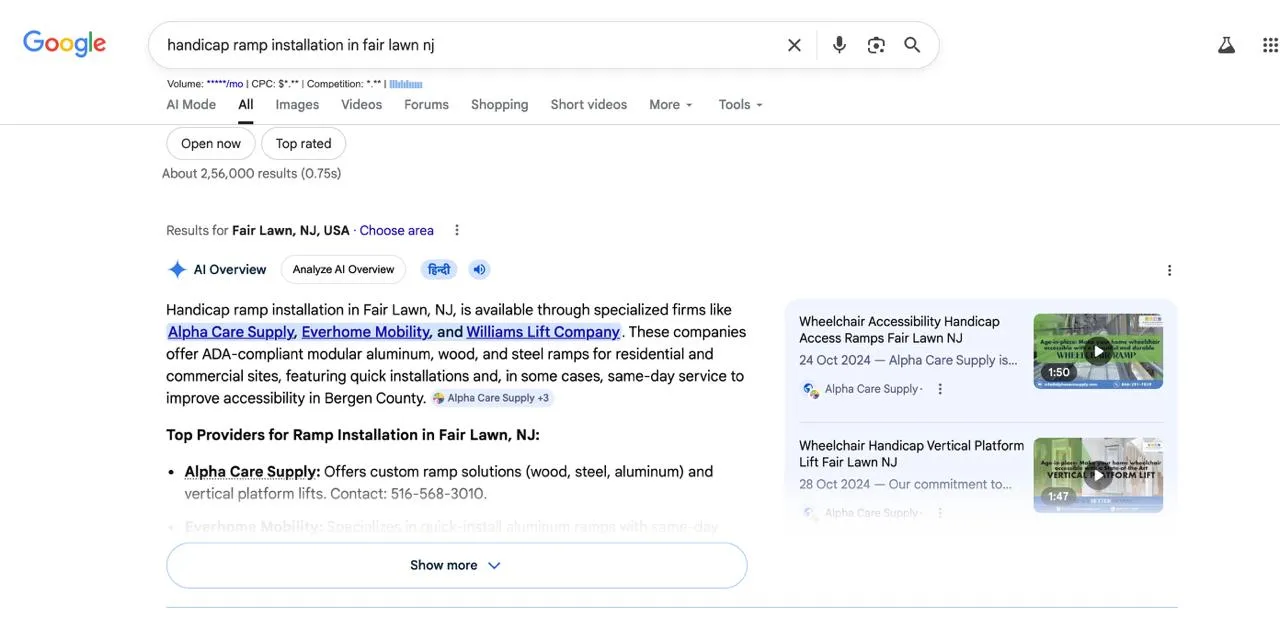
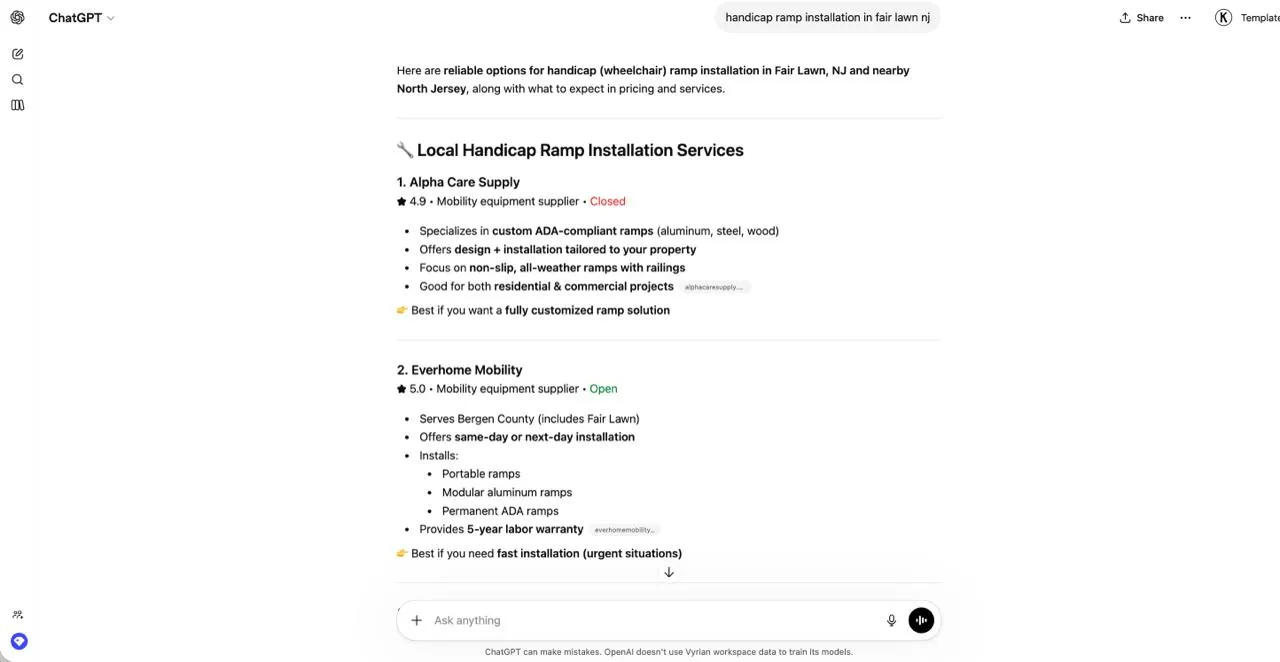
This isn't a coincidence or a paid placement. ChatGPT and Google AI Overview each independently surfaced Everhome — based on the entity work, structured data, and consistent third-party signals we built. Most agencies can show you a SERP screenshot. We can show you the AI answer.
Because they dominate the underlying rankings.
AI engines don't pick random brands to cite. They cite the brands that already rank well on the head terms, have clean entity signals, and own the local map pack. Below: live ranking + geo-grid data for Everhome, pulled from the Max Growth platform — our in-house SaaS that tracks every client every week.
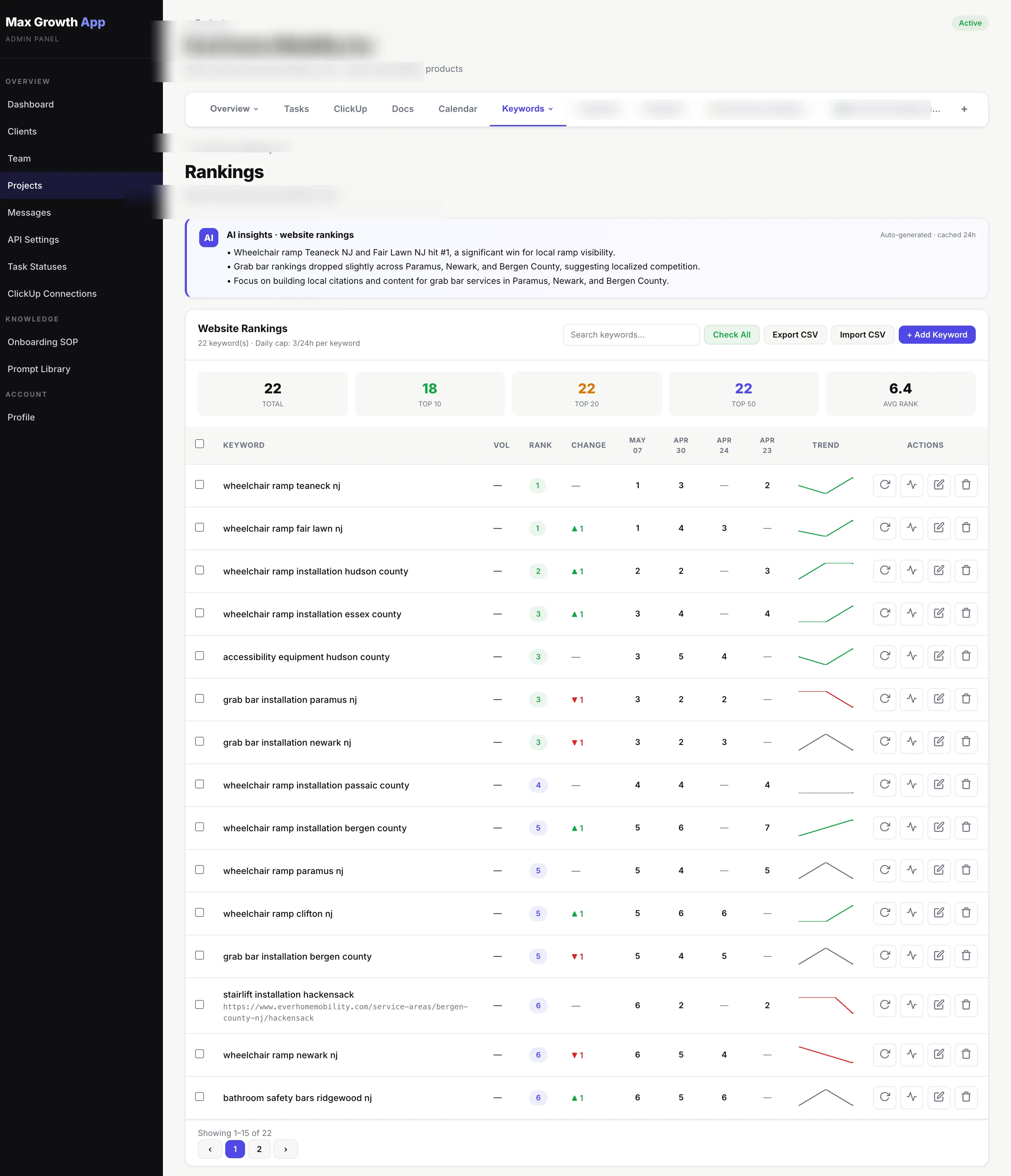
When AI engines crawl for "best handicap ramp installer in Fair Lawn NJ," they find Everhome ranked #1 for the underlying head term. That's why they cite them.
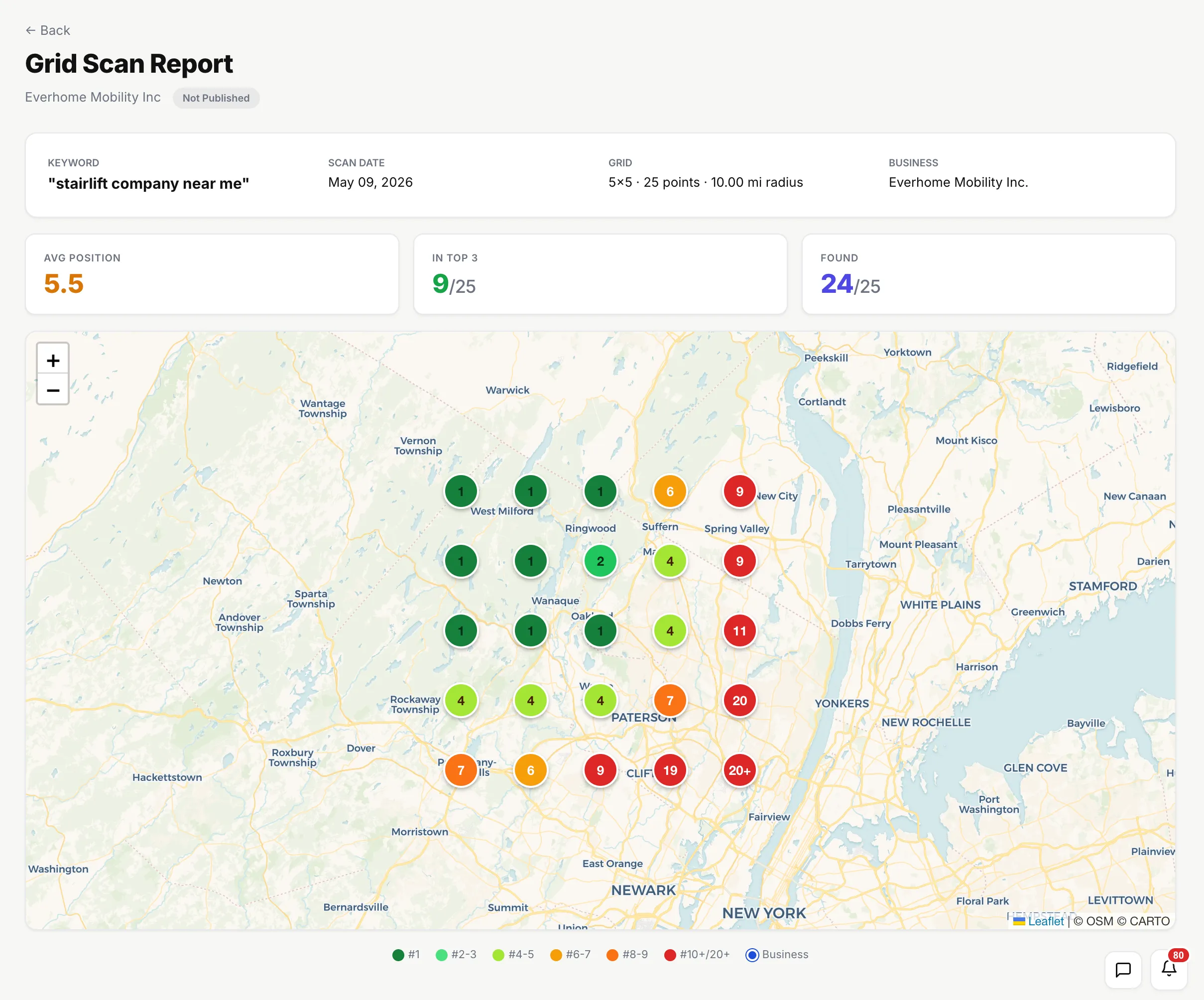
Local map-pack dominance across the entire service area. AI engines reward brands with consistent local presence, not just a single centroid ranking.
The four levers of AI search visibility.
Entity clarity
LLMs build a model of who your brand is — the services you offer, cities you serve, attributes that distinguish you. If that model is fuzzy or inconsistent across the web, the LLM doesn't cite you. We tighten it: schema, llms.txt, knowledge-panel optimization, NAP consistency, About-page clarity. All the signals that say "this is who they are" in machine-readable form.
Topical authority
AI engines weight depth over breadth. They cite the brand that has 30 pages of substantive content on a topic, not the brand with 300 thin pages on 50 topics. We map the topic graph for your category, identify the highest-leverage entries, and build out the cluster in a structure LLMs can extract cleanly.
Third-party trust
AI engines don't trust your site about your site. They trust mentions of your brand on credible third-party surfaces — reviews, industry publications, podcasts, directories, partner sites. We accelerate the velocity and quality of those mentions. This is the slowest lever to move and the hardest to fake, which is precisely why it's so weighted in AI citation decisions.
AI-citable content templates
AI engines preferentially cite content with specific structures: clear question framing, statistic-led answers, named author + date, expert quotes, comparison tables, FAQ sections. We rebuild your highest-leverage content using templates tuned for LLM extraction — without making it worse for human readers. Done right, the same page reads better to people and gets cited.
Concrete deliverables. Monthly progress you can see.
- AI search baseline report
30-50 head queries run against ChatGPT, Gemini, Perplexity, and Google AI Overviews. We log where you appear, where competitors appear, and the citation gap to close.
- Entity + schema implementation
Organization, Service, Person, FAQPage, Article, sameAs — everything LLMs need to build a clean model of your brand. Including an llms.txt at site root.
- Topical cluster build-out
Pillar + supporting pages designed in an AI-citable structure: definitional leads, statistic-led answers, comparison tables, FAQ schema, expert framing.
- Third-party authority work
Targeted mentions on industry publications, podcasts, expert roundups, directories. Velocity tuned to your competitive density — not a link farm, not a guest-post mill.
- Monthly citation tracker
Single PDF, every month: which AI engines now cite you, sentiment, position vs competitors, deltas, and the next-month plan. No vanity dashboards.
- Bring-your-own-SEO compatible
About 60% of clients buy AEO standalone on top of existing SEO. We coordinate with your in-house team or other agency. No turf wars.
Common questions about AEO & GEO.
What is AEO (Answer Engine Optimization)?
AEO is the practice of structuring content, entities, and authority signals so that AI answer engines — ChatGPT, Gemini, Perplexity, Claude, and Google's AI Overviews — cite your brand when answering buyer questions. It's an evolution of SEO, not a replacement: the same fundamentals (entity clarity, topical authority, trust signals) matter, but the optimization targets and measurement are different. AI engines don't show 10 blue links; they pick a handful of brands to mention. Being one of them is the entire game.
How is AEO different from GEO?
AEO (Answer Engine Optimization) focuses on getting cited inside answers from systems like ChatGPT, Perplexity, and Google AI Overviews. GEO (Generative Engine Optimization) is the broader practice of shaping how Large Language Models perceive and recommend your brand — including training-data influence, entity associations, and brand authority signals that affect any generative output, not just direct citations. In practice, we run them together. Most clients buy the bundle.
How is AEO different from SEO?
SEO targets a SERP with 10 blue links and a few features. AEO targets an answer that names 3-7 brands. SEO is largely keyword + link driven; AEO is largely entity + authority + trust driven. They share infrastructure (clean technical site, structured data, semantic content) but diverge on tactics. The big difference: AEO requires being a recognizable entity to the LLM, which depends on consistent mentions across the wider web — not just on-site work.
How do you actually measure AEO results?
Three layers. First, a baseline: we run 30-50 high-intent queries for your category against ChatGPT, Gemini, Perplexity, and Google AI Overviews, recording when (and how) your brand appears versus competitors. Second, a monthly delta: same queries, monthly. Third, downstream impact: branded search lift in GSC, direct traffic patterns, and AI-engine referral traffic (where available). You see citation count, brand-mention sentiment, and competitive position in one report.
How long until AEO starts working?
Faster than traditional SEO, generally. Some changes — schema fixes, llms.txt, on-page entity disambiguation — can show up in AI answers within 2-4 weeks because LLM crawlers re-index frequently. Building durable authority (cited mentions across the broader web, third-party associations) takes longer — 3-6 months typically. We optimize for both timeframes from day one.
Will SEO still matter in 2026 and beyond?
Yes. Google still drives the majority of search volume. ChatGPT search, Perplexity, Gemini, and AI Overviews are growing fast but haven't replaced traditional search — they're another surface on top of it. The brands that win are the ones present on both surfaces. We never replace SEO with AEO; we add AEO to a sound SEO foundation.
Do I need to be a big brand for AI engines to cite me?
No. Our Everhome Mobility client (a Bergen County, NJ ADA mobility services brand — about as un-famous as it gets) is named in Google AI Overviews and rated 5.0☆ by ChatGPT for handicap ramp installation queries, sitting alongside competitors 10× their size. AI engines care about entity clarity, topical authority for the specific query, trust signals (reviews, structured data, NAP consistency), and unique value props — not raw brand size.
What's included in an AEO engagement?
Discovery + baseline (week 1-2): we run your category in 4 AI engines, audit your current entity footprint, and map the citation gap vs competitors. Foundation (week 2-4): schema, llms.txt, entity disambiguation, content templates designed for LLM extraction. Authority build (ongoing): targeted third-party mentions, review velocity work, AI-citable original research/data assets. Measurement: monthly citation tracker delivered as a single PDF.
Can I add AEO to my existing SEO setup?
Yes — about 60% of clients buy AEO as a standalone package on top of an existing SEO agency or in-house team. We coordinate with whoever owns SEO; no turf wars. The AEO/GEO work plugs into your existing technical site, but the strategy and reporting are separate.
How is pricing structured?
Standalone AEO/GEO package starts at month-to-month retainer rates appropriate to your category and competitive density. Bundle with SEO for better economics. We don't publish fixed pricing publicly because the right scope depends on your starting AI-citation baseline — some clients need 6 months of authority work, others can move the needle in 90 days. Email support@maxgrowthagency.com and we'll send a real quote within 24 hours.
See where you stand in AI search, today.
We run your domain against ChatGPT, Perplexity, Gemini, and Google AI Overviews for 10 high-intent queries in your category. You get a short PDF: what AI engines say about you, what they say about your competitors, and the three highest-leverage moves to flip the citations your way. No call required.
Get a free AI search audit
See where you stand in ChatGPT, Perplexity, Gemini, and Google AI Overviews. PDF in 48 hours. No sales call.