

Google Business Profile Optimization in 2026: The Complete Map Pack & AEO Playbook
A 2026 playbook for optimizing your Google Business Profile for Map Pack rankings and AI search citations. Categories, services, posts, photos, reviews, Q&A, and the local AEO layer most agencies still miss.

On this page · 5 sections
TL;DR
GBP optimization is the single highest-ROI local SEO asset in 2026. Roughly 46% of all Google searches have local intent, and the top 3 Map Pack results capture most clicks. Tune every controllable field — categories, services, products, attributes, posts, photos, reviews, Q&A, messaging — for visibility in Map Pack, Maps, and AI Overviews.
- Primary category dominates the ranking signal — pick the closest available match
- Photos: 25+ minimum; monthly fresh uploads as a freshness signal
- Weekly posts (1-3/week) for activity signal + carousel visibility
- Q&A seeded by the owner; reply to new questions within 24 hours
- Service + product listings filled with descriptions + photos
- Reviews: 5-15/month sustained; 100% reply on negatives, 50%+ on positives
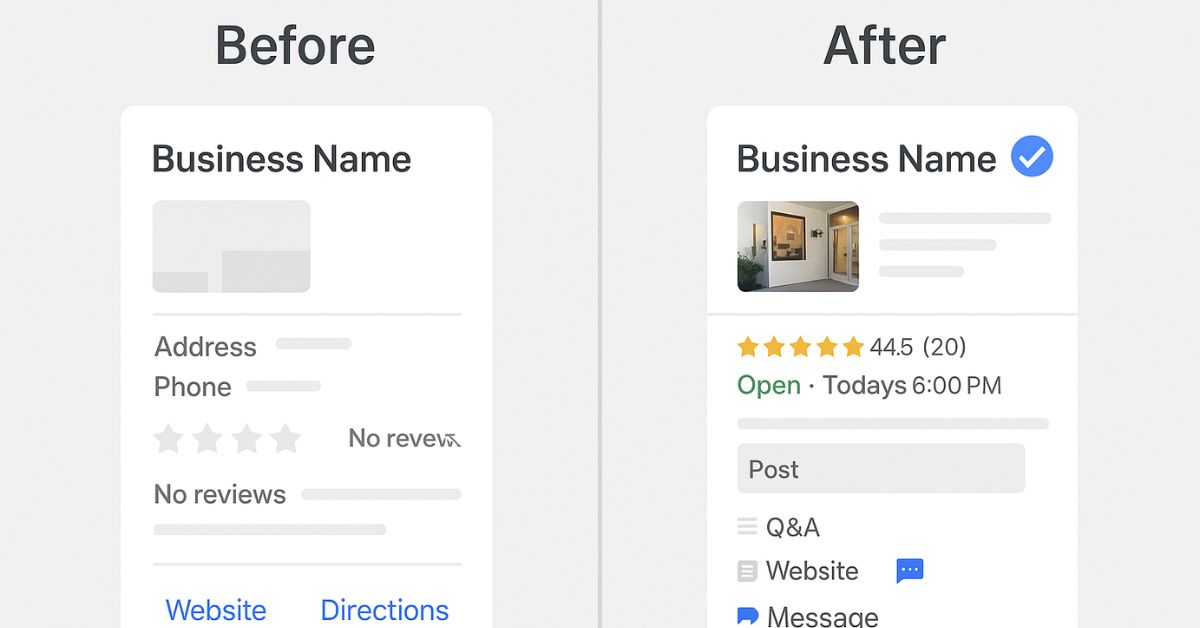
Google Business Profile (GBP) optimization is the practice of tuning every controllable field of your business profile — categories, services, products, attributes, posts, photos, reviews, Q&A, messaging — to maximize visibility in the local Map Pack, Google Maps, and increasingly in AI Overviews when buyers ask geo-qualified questions. In 2026, a fully optimized GBP is the single highest-ROI local SEO asset for any service-area business: ~46% of all Google searches have local intent, and the top three Map Pack results capture the majority of those clicks.
This guide is a complete 2026 playbook. We cover every field that actually moves rankings, the local AEO layer that most agencies haven't caught up to, and the schedule + workflow that turns a one-time optimization into compounding local visibility. Built from active US client work: 68 calls per month on one law firm, 0.2 average map rank on Local Falcon for an auto body shop, and AI Overview citations for a Bergen County NJ mobility business.
What's new in 2026 GBP optimization
Six things changed materially in the last 12 months. If your last optimization was in 2024 or earlier, all six matter:
- AI Overview integration. Google AI Overviews now pull from GBP data structurally — categories, services, attributes, review snippets, and Q&A all surface in AI answers. Your GBP is no longer just feeding the Map Pack; it's feeding AI search.
- Stricter service-area rules. Service-area businesses can no longer display a public address if they don't accept customer visits there. Hybrid storefront/SAB listings are being phased out.
- Products + services merged. Many categories now show "services" and "products" together in the consumer-facing view. The fields are still separate in the dashboard but display unified.
- Tighter review-quality detection. Incentivized reviews (paid, gifted, prompted with discounts) are caught with higher accuracy in 2026 — review removal and ranking demotion follow.
- Posts surface in more places. GBP posts now appear in Maps, Search, AI Overviews citations, and Discover. Frequency matters more than length.
- Photos with AI metadata. Photos uploaded with descriptive filenames, alt context, and EXIF location data weight more in 2026 than they did pre-AI-Overview.
The 8-track GBP optimization framework
1. Categories: primary + up to 9 secondary
The single highest-impact field. Your primary category is what Google considers your business's main offering — it's the strongest single signal for what searches you should appear in. Pick the most specific category that fits, not the broadest. A "Personal Injury Attorney" outranks a "Lawyer" for personal-injury-specific searches almost universally.
Add up to 9 secondary categories covering your real adjacent services. Don't stuff irrelevant ones — Google's category-mismatch detection catches this and demotes the profile. Audit competitor categories using free tools like Pleper's GBP Categories tool to find ones you might be missing.
2. Services list (and pricing where applicable)
List every service you actually offer, with short descriptions (50-200 characters each). Services are now used by AI Overviews to determine whether your business should be cited for a specific query. Gaps in your services list are gaps in your AI footprint.
Add pricing where you can — categories that allow price ranges (legal, mobility, home services) benefit from the additional structured-data signal. Pricing also filters out unqualified leads at the search stage, which improves call quality.
3. Products (where eligible)
For categories with product listings enabled (retail, mobility, automotive, some home services), products are a separate field from services. Each product gets a photo, title, description, and price. Products appear inline in the consumer-facing profile and feed AI Overview citations.
4. Attributes
Attributes are the structured Yes/No tags that signal accessibility, payment options, service options, amenities, ownership, and identity. Categories like LGBTQ+ friendly, women-owned, veteran-owned, wheelchair-accessible, and "online appointments" surface prominently in the AI Overview and Map Pack snippet.
Check every attribute that genuinely applies. Don't fake them — users notice and Google's signal validation catches inconsistency.
5. GBP posts (the under-leveraged lever)
Posts in 2026 are no longer just a Maps card. They appear in Search snippets, AI Overview citations, and the Discover feed. Frequency matters more than length. Two short posts per week beats one long post per month.
- What's New posts — weekly updates, announcements, new services.
- Event posts — for promotions, openings, sales (auto-expire on date).
- Offer posts — with CTA, valid date range, photos.
- Update posts — for static info like new hours, COVID protocols (still relevant in some categories).
Cadence: 8-10 posts per month, mix of types. Always with a photo or short video. Always with a CTA.
6. Photos + videos (with AI metadata)
Upload 10+ photos in the first 30 days, then 2-4 fresh photos per month ongoing. Categories: exterior with signage, interior workspace, team, work-in-progress, completed projects, before/after where relevant.
2026 best practice: name files descriptively (e.g., "wheelchair-ramp-installation-teaneck-nj.jpg" beats "IMG_0394.jpg") and let EXIF location data ride along when shot on a phone at the actual location. AI engines extract this metadata when citing local businesses.
Short videos (30-60 seconds, vertical) of completed work or team intros perform well in 2026. Don't fake polish — raw, real video outperforms agency-produced reels.
7. Reviews (and response cadence)
Reviews are the most underweighted ranking signal in local SEO. A business going from 0-1 reviews/month to 5 reviews/month consistently for 6 months typically jumps 5-10 positions in the Map Pack, often more.
- Set up a review-request workflow triggered by ops events (job completion, invoice send, appointment close).
- Use SMS + email asks. SMS converts at 25-40% on a polite ask within 24 hours of the service.
- Respond to every review, positive and negative, within 24-48 hours. Personalized response — not "Thanks for the review!"
- Never pay for reviews. Never offer discounts for reviews. Google's 2026 detection catches this and the penalty isn't worth the short-term lift.
8. Q&A (the field most businesses ignore)
Anyone can post a question on a GBP. Most owners never seed their own Q&A — which means the first question shown is whatever a random user asked, often unfavorably worded.
Seed 8-12 questions yourself covering the actual questions your customers ask: pricing, service area, hours, what's included, how to book, what to expect. Answer each thoroughly. Upvote the best answers. Q&A content is now extracted into AI Overviews for geo-qualified queries.
The local AEO layer: what most agencies miss
Optimizing for the Map Pack is half the battle in 2026. The other half: getting cited inside ChatGPT, Perplexity, Gemini, and Google AI Overviews when users ask "best X near me" or "wheelchair ramp installer New Jersey." This is where 90% of local SEO agencies haven't caught up.
The three levers that move the AI citation needle for local:
- Entity-clean schema on your website — LocalBusiness, Service, FAQPage, BreadcrumbList. AI engines extract these structurally; missing or malformed schema is invisible.
- A content footprint that matches the AI query patterns — local service pages with definition leads, statistic-led sentences, comparison tables, FAQ sections. The format AI engines prefer to cite.
- llms.txt at your site root — an emerging standard that helps AI crawlers index your priority pages. Most local businesses don't have one in 2026; getting ahead now compounds.
One of our clients in Bergen County NJ — an ADA wheelchair ramp installer — is now cited by name with 5.0-star rating inside Google AI Overviews and ChatGPT for geo-qualified queries like "wheelchair ramp Teaneck NJ." The Map Pack and AI Overview now reinforce each other. See our local SEO services for the full local AEO playbook.
The monthly maintenance schedule
Optimization is not a one-time task. After the initial 30-day setup, a typical monthly GBP cadence:
| Frequency | Task |
|---|---|
| 2× weekly | GBP post (What's New, Event, Offer, or Update) |
| Weekly | Photo or short video upload (2-4 per month) |
| Daily | Review response within 24-48 hours of receipt |
| Weekly | Review-request batch (SMS + email to recent customers) |
| Monthly | New Q&A seeding or refresh (1-2 questions/month) |
| Monthly | Local Falcon grid scan + screenshot |
| Quarterly | Category audit (competitor + market scan) |
| Quarterly | Services list refresh + new service additions |
| Quarterly | Photo refresh (archive old, upload current) |
The bottom line
A fully optimized GBP in 2026 isn't a one-time setup — it's a maintained asset that compounds month over month. The categories + services + attributes work in week 1 unlocks the Map Pack visibility. The post + photo + review cadence in months 2-12 compounds the rankings and unlocks AI Overview citations. Most service-area businesses see meaningful Map Pack movement in 30-60 days; AI citations follow in 60-120 days when the website schema and content footprint are right.
If you want this done end-to-end on your account — our local SEO retainer covers every track above. If you'd rather do it yourself, this checklist is fully executable in-house with 5-10 hours per month of disciplined work.
01 What does a fully optimized Google Business Profile look like in 2026?
02 What's the most important field on Google Business Profile?
03 How often should I post on Google Business Profile?
04 Do GBP posts affect rankings?
05 How do I rank in the Google Map Pack?
06 Will optimizing my GBP get me cited in Google AI Overviews?
07 How many photos should I upload to GBP?
08 How long until GBP optimization shows ranking results?
09 Can I rank in the Map Pack without a physical location?
10 Should I hire an agency for GBP optimization or do it in-house?
Deepika Bhardwaj is the Founder of Max Growth Agency, where she helps businesses scale through strategic SEO, high-impact Content Marketing, and authoritative Digital PR. With years of hands-on experience in building organic visibility and brand trust, Deepika specializes in data-driven growth strategies that consistently deliver results.
Related posts
Outsourced Google Business Profile Optimization in 2026: The Operating Model

Google Business Profile Verification in 2026: Methods, Timelines & What to Do When It Fails
10 Google Business Profile Mistakes Gurgaon Businesses Make in 2026 (And How to Fix Them)
Content Optimization Tips for SEO + AEO in 2026: 12 Tactics That Actually Move Rankings
Get a free AI search audit.
We run your domain against ChatGPT, Gemini, Perplexity, and Google AI Overviews for 10 high-intent queries in your category. Short PDF, 48 hours, no sales call.
Email support@maxgrowthagency.com